 Norvane Systems
What is bedtime procrastination?
The researchers who named it in 2014 defined bedtime procrastination as “failing to go to bed at the intended time, while no external circumstances prevent a person from doing so” (Kroese et al., 2014).
The key word is intended. You planned to be in bed by 11, and it’s 12:40. Nothing kept you up: no deadline, no baby, no night shift. You just didn’t go. That also makes it different from insomnia. You could fall asleep; you just haven’t gone to bed.
Sound familiar?
- You’re tired, but you keep watching “one more” video.
- You know when you want to be asleep, and you rarely make it.
- Your evening routine starts late, or not at all.
- Mornings feel rushed, and you promise tonight will be different.
Why is it called “revenge” bedtime procrastination?
The “revenge” version comes from China, where the phrase 报复性熬夜 (bàofùxìng áoyè), roughly “revenge staying up late,” described people with long workdays staying up to win back some time of their own. It spread in English in 2020.
The revenge is against a day that didn’t leave room for you. The catch is that tomorrow morning pays for it.
Why you put off going to bed
Bedtime procrastination usually isn’t laziness. It comes from a few ordinary things stacking up at the end of the day:
- The evening is your only free time. After work, chores or family, the hours before bed are the first ones that belong to you, so ending them feels like losing them.
- Bedtime has no clear start. Nothing says “now.” Getting ready begins whenever the scrolling stops, and a feed never stops by itself.
- Your phone is built to keep you there. Endless feeds and autoplay turn “just checking” into an hour.
- You’re tired. After a long day, stopping something easy and enjoyable takes effort you don’t have left.
- Tomorrow is on your mind. Unfinished tasks keep circling, and the phone feels easier than lying in the dark thinking about them.
If scrolling is what keeps you up, read how to stop doomscrolling in bed.
How to stop: make a plan, not a promise
“I’ll go to bed earlier tonight” is a promise, and promises are easy to break at 11 p.m. A plan decides what happens, when, and what you’ll do instead, before you’re tired. Here’s one that holds up:
- Pick a bedtime you can keep. Choose the time your phone goes down. Start 15 to 30 minutes earlier than you usually manage, not two hours.
- Work back to a start time. If you want to be in bed at 11 and getting ready takes 45 minutes, your evening starts at 10:15. That start time is the moment that matters.
- Keep the routine short and specific. Two to five things you’d actually do, like a shower, skincare and reading, each with a length. Here are three routines you can copy.
- Switch off the apps that keep you up. Decide which apps stop at the start time, usually social, video and news, and keep the rest: music, audiobooks and your alarm.
- Park tomorrow before bed. Write down what’s on your mind so you don’t have to hold onto it; here’s how to do a brain dump before bed. In a 2018 sleep-lab study, young adults who spent five minutes writing a to-do list fell asleep about nine minutes faster, on average, than those who wrote about tasks they had already finished (Scullin et al., 2018).
- Give yourself free time earlier. If the evening feels like your only time, set aside a guilt-free hour with a clear end, so you don’t have to take it back from your sleep.
- Plan for late nights. Running late? Do the short version, skip a step or shift the evening. A plan that bends doesn’t break.
How Unhaste puts the plan on autopilot
We built Unhaste for iPhone for exactly this moment. Set your plan up once, and it runs every evening:
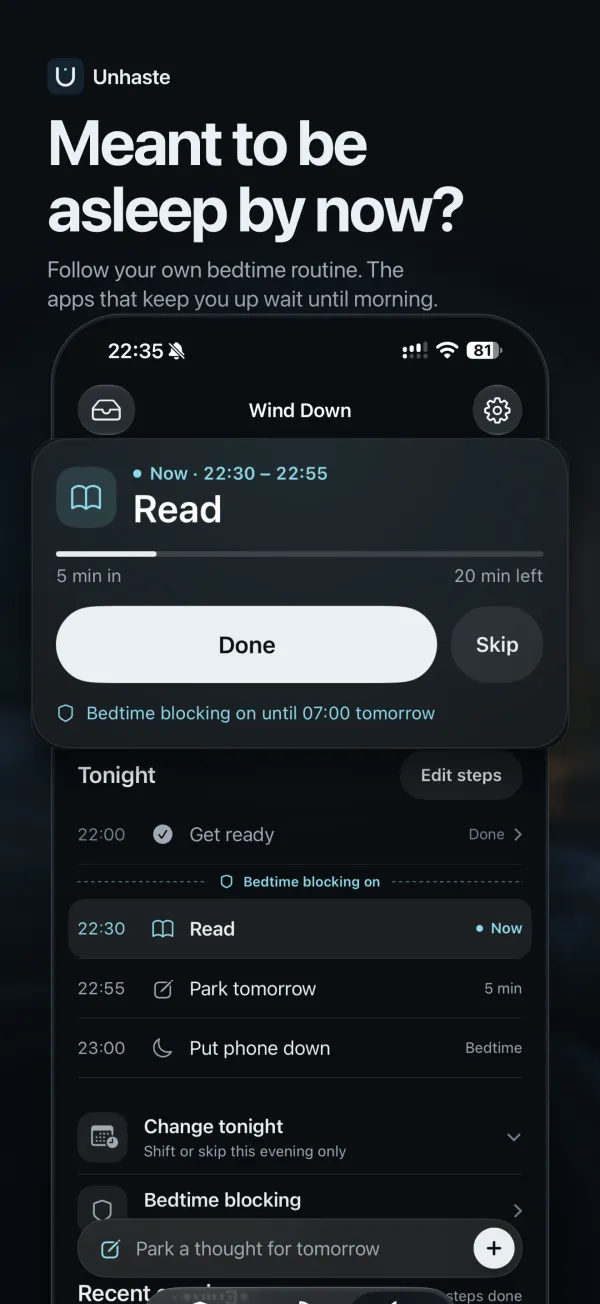
- A routine with a clear start. Build your evening from up to eight steps, like a shower, reading, stretching, or your own. Unhaste times them back from your bedtime and chimes softly as each step starts.
- Bedtime blocking. Choose the step where the apps that keep you up switch off. They stay off until the morning time you set, while music, books and your alarm stay available.
- Room for real life. Running late? Do a step late, skip it, or shift just tonight.
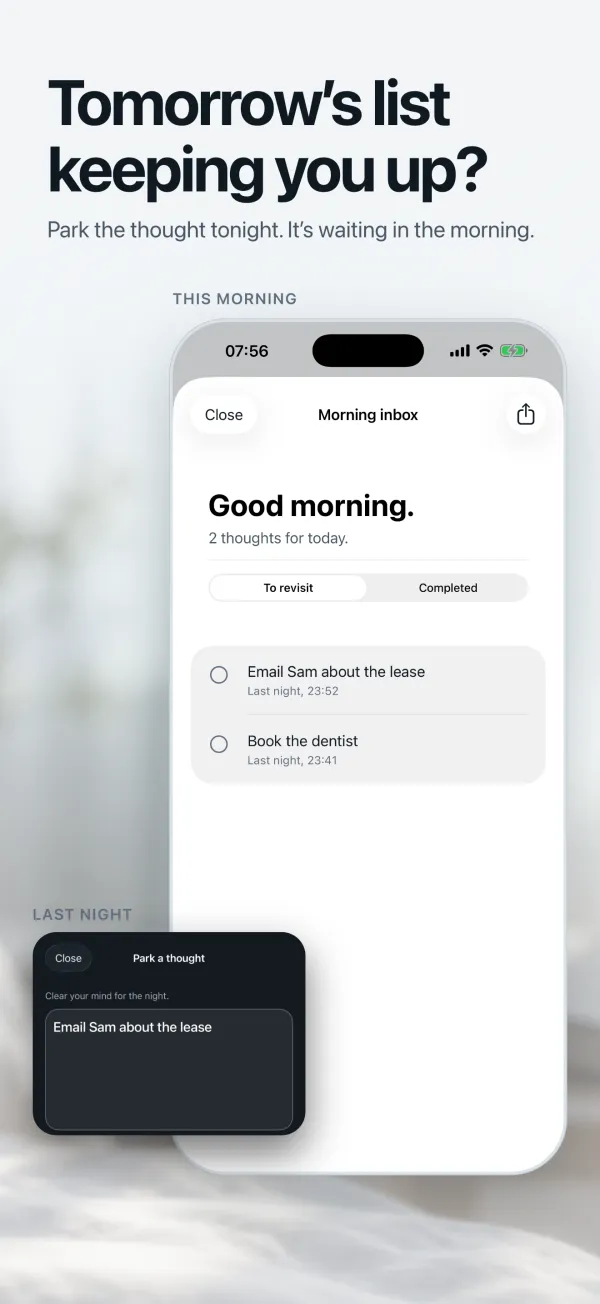
- A place for tomorrow’s thoughts. Park a thought in seconds. It’s waiting in your morning inbox.
See every way Unhaste blocks apps, from a few opens a day to focus sessions.
Questions and answers
Is revenge bedtime procrastination a sleep disorder?
No. It’s a habit of putting off bedtime, not a medical condition. If you have trouble falling or staying asleep even when you go to bed on time, talk to a doctor.
How do I stop revenge bedtime procrastination?
Pick a realistic bedtime, work back to a start time, keep your routine short, and switch off the apps that keep you up from that start time until morning. Unhaste sets all of this up on iPhone in a few minutes.
Why do I stay up late when I’m tired?
Usually because the evening is the only time that feels like yours, and your phone makes it easy to keep going. A set start time and a few apps switched off at night make stopping the default instead of a decision.
Does Unhaste lock my whole phone?
No. It blocks only the apps you pick, so music, books, your alarm and everything else stay available.